
MIND MAPPING AS AN INNOVATIVE MEANS OF TEACHING ENGLISH
Are you a creative teacher of English or a motivated English learner?
Do you search for any innovative techniques to teach or learn English?
There is good news for you, as among a great variety of innovations admitted to be effective you can find mind mapping which proves to boost the process of mastering the language.
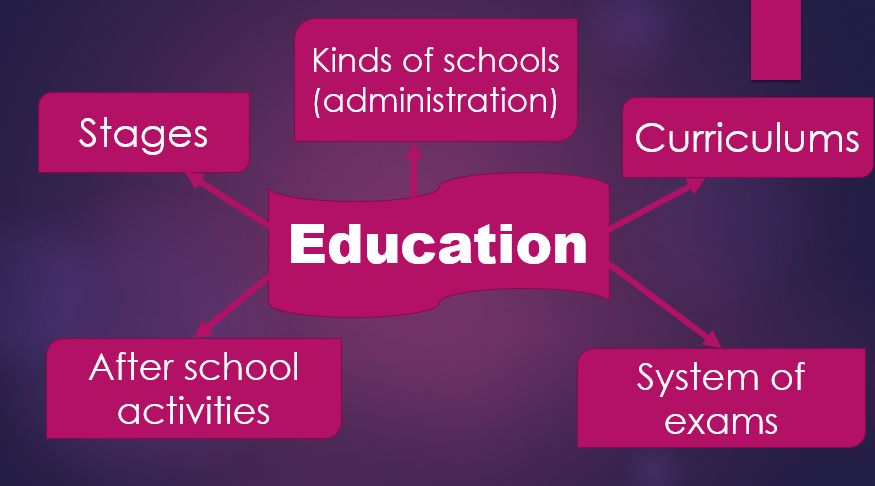
Mind mapping is a technique which helps students visualize, organize, and remember language concepts effectively. It can enhance their awareness of grammar, vocabulary, and other language components, expressing them with diagrams and other forms of graphical representation of knowledge and thinking process. Mind maps can structure language components into cognitive complexity and coherence. Thus, such technique supports the development of speaking competence as well. You just place the related concepts of a topic in a circle or a square or some other symbol, and then link the related concepts with a line to indicate the relationships between them.
This innovative technique is rather helpful in developing creative and critical thinking skills as well as soft skills. It teaches to think “up” (taking into consideration separate details of the language phenomena under study and generalizing them into a proper scheme image) and “down” (from general idea to its components and details).
Mind mapping can be applied to different goals of English teaching process. Let’s see how it works dealing with teaching or learning vocabulary, grammar and developing speaking competence.
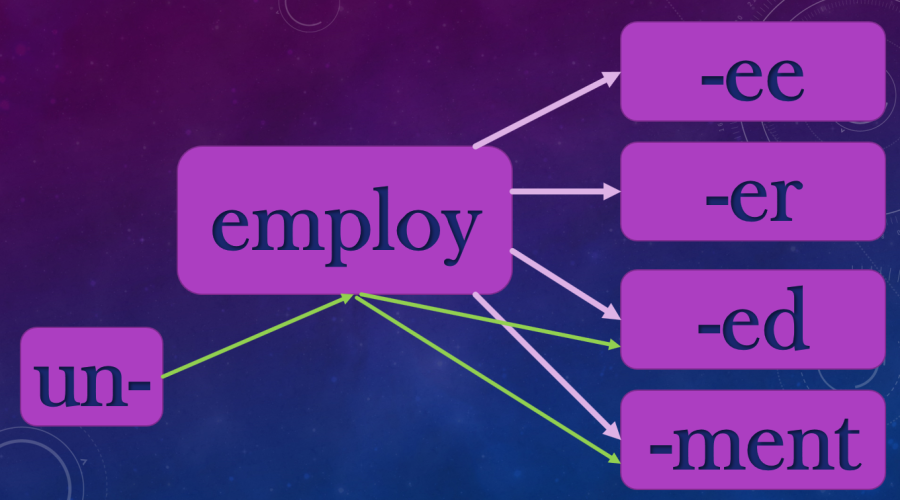
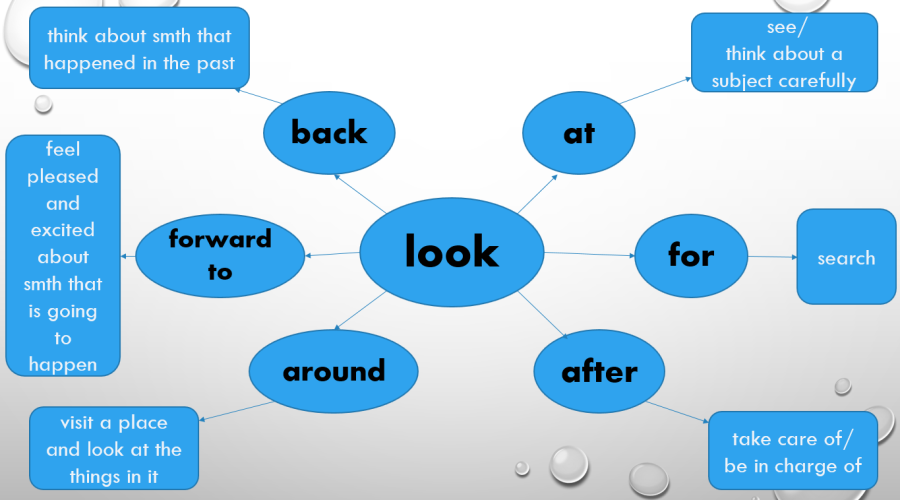
Studying phrasal verbs, either a teacher or a student can construct a map with a verb in the central circle and prepositions or adverbs, which influence the final meaning, around it, with further links to definitions/ or demonstrative pictures/ or translation. It is also possible to make students get used to design in their minds the map of possible derivatives, and thus, teach them to enlarge their vocabulary. Derivation is one of the most productive method of word formation, which refers to the relationship between root and affixes. Mind mapping is helpful for students to analyze the morpheme composition of words, so that students can expand vocabulary from one morpheme to other words, so as to deepen their understanding of the meaning of words and expand their vocabulary efficiently.
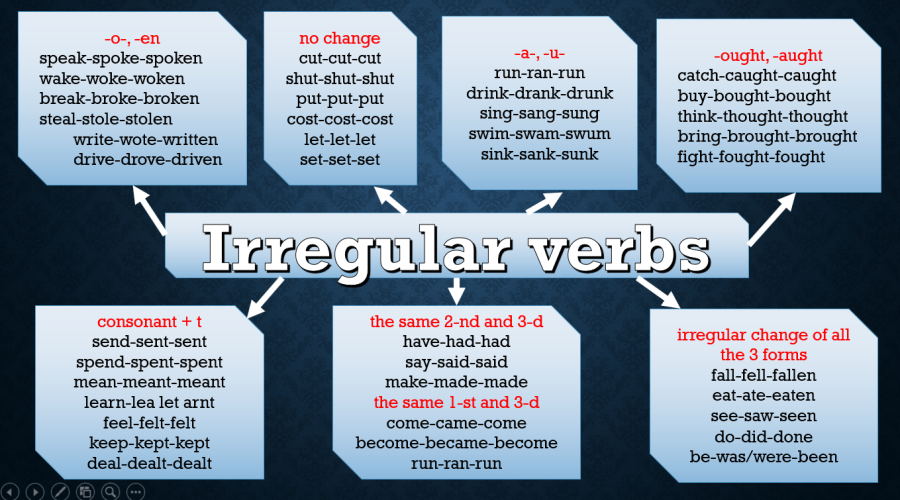
As for the grammar, mind mapping also proves to be helpful. Imagine grouping the irregular verbs not in alphabetic order but paying attention to its spelling similarities. Or word order presented as a multi-coloured train in which each carriage demonstrates a proper syntactical member of the sentence. It attracts the student’s attention stimulating creative thinking and having pleasure instead of dull exercising or memorizing.
Divergent thinking mode is used to guide the thinking process, expand the thinking content, and visualize the thinking process. Mind maps reflect this and can therefore be effective in anticipating speaking or writing activities. Mind mapping provides visualizing the ideas in their logical order and result in outlining the future speech or an essay.
So, educational technologies have contributed greatly to the improvement of the process of education. Mind mapping can be considered as a teaching method to raise motivation and meaningfulness with its features being contextual, visual, sometimes multi-dimensional and interactive. It is an effective innovative tool to make student active while learning English. It provokes reflection with its analysis and leads to improved fluency and communication skills. Mind mapping as an alternative teaching method that can help you become a more effective English teacher or learner as supports you with active and creative approach to the process of studying English.
No responses yet